Since late 2025, the Federal Motor Carrier Safety Administration (FMCSA) has revoked dozens of electronic logging devices (ELDs) from its registered devices list for failing to meet minimum federal requirements. As of May 4, 2026, any motor carrier still operating on one of those devices is considered to be operating without an ELD. Drivers found using a revoked device are cited under 49 CFR 395.8(a)(1) and placed out of service in line with the Commercial Vehicle Safety Alliance (CVSA) Out-of-Service Criteria.
For fleet leaders, this is the moment to take a hard look at the compliance workflow behind your electronic logging program. The next FMCSA bulletin is not a question of if. It is a question of when.
Why the FMCSA ELD Compliance Crackdown of 2026 Should Be on Every Fleet’s Radar
The FMCSA has steadily accelerated its enforcement posture. Four devices were removed at the end of 2025, nine more in early 2026, fourteen on March 4, and another two on May 7. The agency is publicly testing each registered ELD against the technical specifications in 49 CFR Appendix A to Subpart B of Part 395 and removing those that fall short.
FMCSA Administrator, Derek D. Barrs put the agency position plainly when the fourteen devices were revoked: meeting federal requirements is not optional, devices that fall short will be removed, and the standard will be enforced fairly and firmly because safety depends on it.
The practical implication for motor carriers is that registered does not mean permanently approved. The list changes. If your compliance process is not built to detect those changes quickly, your drivers are exposed to roadside out of service findings, audit exposure, and the operational fallout that comes with both.
What an ELD Removed From the Registered List Actually Means for Your Drivers
When an ELD is revoked, motor carriers have up to sixty days to discontinue the device, revert temporarily to paper logs or compliant logging software, and replace it with a registered device. Sixty days is a short window. For a multi-terminal operation, there is barely enough time to surface the issue, evaluate replacement vendors, deploy hardware, retrain drivers, and document the switch without disrupting dispatch.
Once the sixty day grace period closes, the legal status of any truck still running the revoked device changes. The driver is no longer operating with a partially compliant ELD. The driver is operating without an ELD at all. That is a different category of violation, and it brings a different category of consequences.
Building a Weekly Internal Control on the FMCSA Revoked ELD List
The most underrated defense against registered device risk is a simple, repeatable weekly check. FMCSA publishes both the registered devices list and the revoked devices list on its public ELD portal. Every motor carrier should assign clear ownership of a recurring task. Someone reviews both lists on a fixed day each week and cross checks the model and version numbers in use across the fleet.
That work should be documented. Date the check, capture who performed it, note any matches against your active device inventory, and store the supporting screenshots in a compliance folder. When FMCSA or an insurance auditor asks how you knew the devices in your trucks were still registered, you will need to produce evidence rather than rely on memory. This is not a one time setup. New revocations have been arriving roughly every six to eight weeks. Treat the check as a permanent fixture on the compliance calendar.
Tightening Procurement to Keep a Future Revoked ELD Out of Your Fleet
The weekly check tells you what is happening today. Procurement protocols decide what enters the fleet tomorrow. A few practical controls reduce the chance that a future revocation lands hard:
Before approving any new ELD vendor, confirm the model and version appear on the current FMCSA registered devices list and have never appeared on the revoked list. A device that was once removed and then reinstated is a different risk profile than one that has never been flagged.
Require the vendor to commit in writing to a defined response window if their device is ever removed. You want to know what they will do, what they will pay for, and how quickly they will replace a device, before you sign a contract with them.
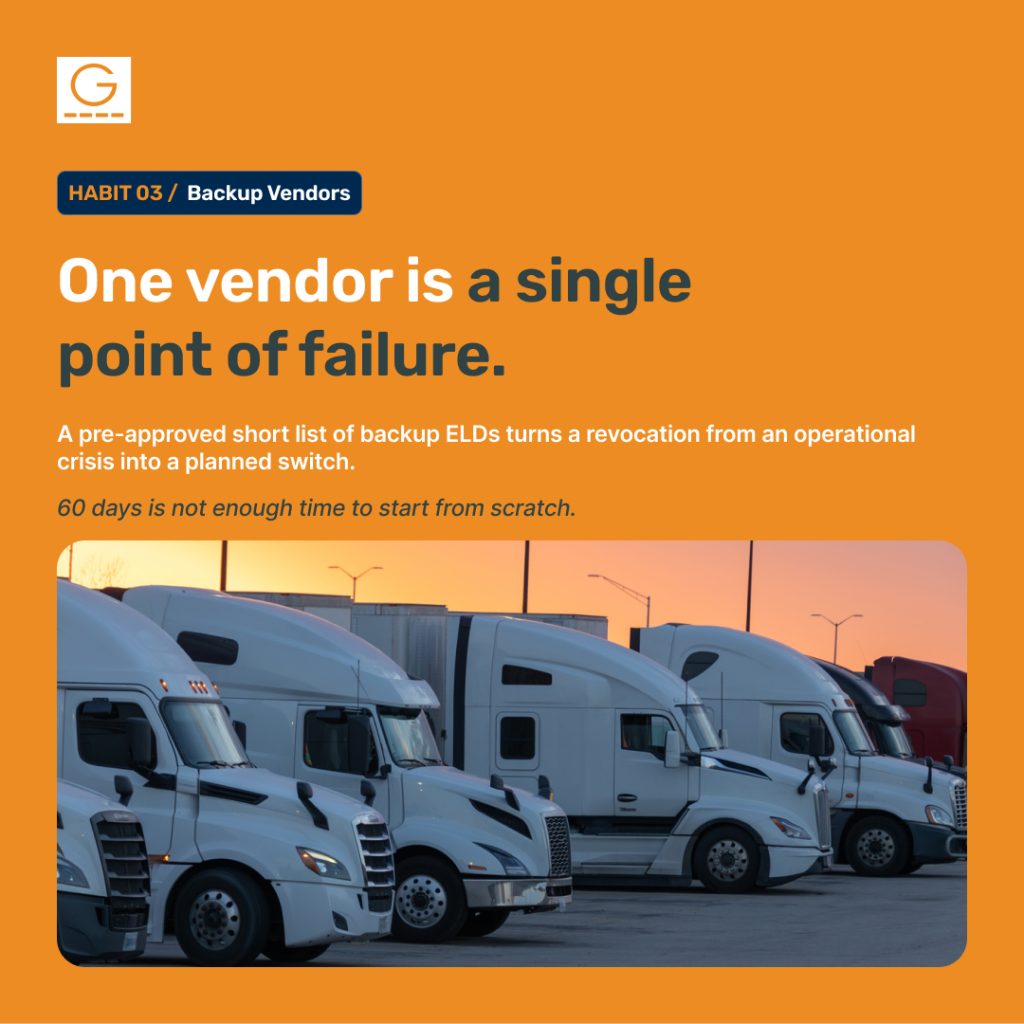
Maintain a short list of pre approved backup ELD vendors that can deploy quickly. If you only have one option in your stack, a revocation becomes an operational crisis. If you have two, it becomes a planned switch.
Standardize the model across the fleet wherever possible. Mixed device environments make verification harder and make any future replacement project significantly more painful.
The Out of Service Risk When Operating Without an ELD
The downstream cost of missing a revocation shows up in two places:
Roadside enforcement: If a driver is placed out of service for using a revoked ELD, the truck cannot move. That means delayed loads, impacted customers, and added costs for the carrier. Repeated findings across multiple drivers can also hurt your Compliance, Safety, Accountability (CSA) score, which may affect insurance premiums and shipper confidence.
Audit exposure: During an hours-of-service audit, regulators will expect to see a documented process for monitoring registered device status. They may also review how you manage related risks, such as ELD tampering or false logs. A reactive response is not enough. A clear, consistent process matters.
HOS Protect as the Compliance Workflow Backstop
Gridline HOS Protect is built for exactly this layer of the compliance picture. It is an oversight management tool that helps drivers and supervisors stay compliant with federally mandated hours of service rules, with all violations flowing into a single workflow so nothing slips through.
The platform automates the violation review, captures supervisor corrective action and driver acknowledgment electronically, and stores the audit trail on a defensible retention schedule. When an ELD revocation forces a temporary reliance on paper logs or a vendor switch, HOS Protect ensures the surrounding workflow stays intact. Supervisors are still coaching and documentation is still complete. The 24×7 view of how each terminal is adhering to process does not break just because the device underneath it changed.
Registered Device Risk Is a Process Problem, Not a Vendor Problem
The 2026 enforcement crackdown rewards fleets that built compliance into their operating rhythm and exposes the ones that did not. The carriers most at risk are not the ones who picked the wrong ELD. They are the ones with no internal process to know whether their ELD was still registered last week.
Put simply, the most resilient carriers are:
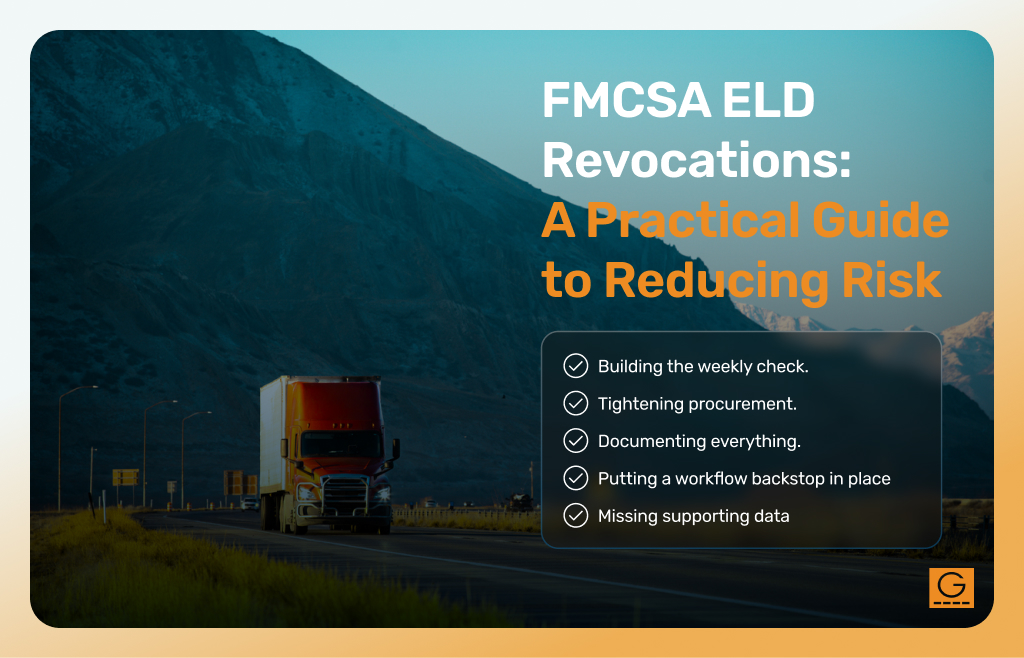
Building the weekly check.
Tightening procurement.
Documenting everything.
Putting a workflow backstop in place, so that when the next revocation lands, the operation absorbs it, rather than getting disrupted by it.
To learn how HOS Protect can sit behind your ELD program as the workflow backstop, schedule a demo with the Gridline team.
Turn your fleet data into profitable actions
Learn more about Gridline fleet management analytics by reaching out below:
We use cookies to ensure that we give you the best experience on our website. If you continue to use this site we will assume that you are happy with it.