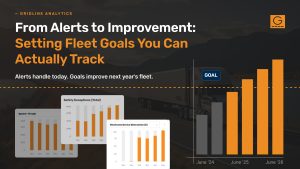
Every fleet sets goals around the same handful of metrics: reducing idle time, cutting speeding events, managing driver safety with video, or keeping HOS violations off the board. The trouble is that those goals usually live in a dashboard or spreadsheet that only a manager ever opens, while the drivers responsible for hitting them find out how they performed long after the fact. Gridline Mobile changes that. It puts every driver’s own performance data, and the company goals behind it, right in their pocket.
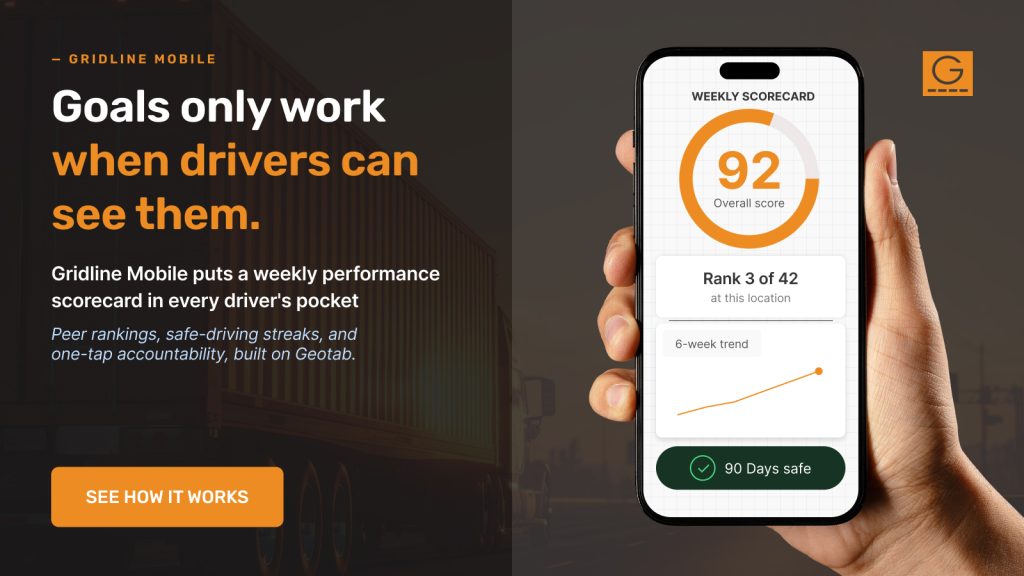
In most fleets, performance data travels a long road before it reaches the person behind the wheel. The telematics platform collects it, a manager exports and interprets it, and the findings finally surface in a meeting or a printout, by which point the feedback describes behavior that is already old. The manager becomes a middleman between drivers and their own numbers, and drivers are left working in a blind spot, unable to tell whether they are on track. The cost is highest in incentive programs, where a driver can spend the entire time assuming everything is fine, only to learn at payout that a string of idling events erased their bonus. And because drivers spend their days on the road rather than at a desk, any tool that depends on a desktop login was never going to reach them in the first place.
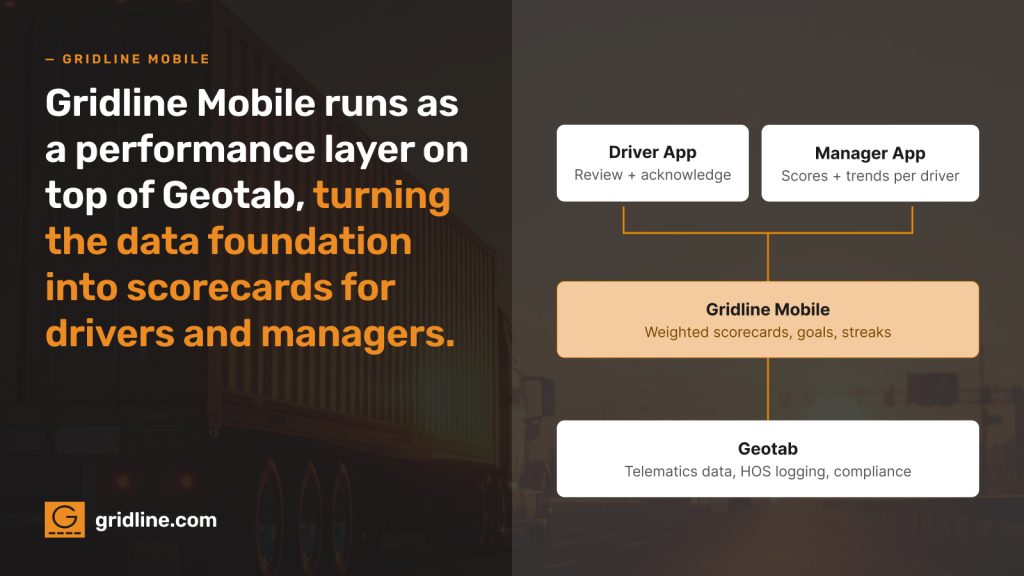
Gridline Mobile solves this by delivering the data directly to the people it describes. The app runs as a performance layer on top of Geotab, which continues to handle the foundation of telematics data collection, HOS logging, compliance, and video safety. Geotab reliably records what happened; Gridline Mobile translates that record into performance insight, showing every driver and supervisor exactly where they stand against the goals the company has set. We recently covered how fleets use Gridline Analytics to set meaningful goals from historical data, and Gridline Mobile extends that same discipline to the people who determine whether those goals are met. A target defined in the analytics portal, such as bringing fleet idling down to 10 percent, becomes a number every driver can track against their own daily habits.
Before Gridline Mobile
With Gridline Mobile
Where performance data lives
In dashboards and spreadsheets managed by the back office
On every driver’s and supervisor’s phone
When drivers get feedback
Weeks later, in meetings or printouts
Every Monday morning on their weekly scorecard
Incentive visibility
Bonus status discovered at payout
Progress tracked against incentive metrics all quarter long
Recognition for safe driving
Feedback arrives only when something goes wrong
Streaks celebrate milestones like 78 days without a violation
How managers find at risk drivers
Building and combing through spreadsheets
Scores and trend lines surface at risk drivers automatically
Coaching conversations
Long scheduled reviews built on stale data
Two minute conversations grounded in fresh, shared numbers
Driver acknowledgement
During coaching conversations or quarterly reviews with management; no documented records to hold drivers accountable with owning feedback
Weekly acknowledgement button means drivers must confirm review and acknowledgment of feedback; captures weekly record of driver feedback ownership and measure of accountability
Coaching documentation
Fleet managements assume feedback is received during sessions and rely on risky driving events as evidence of at-risk behavior.
Weekly acknowledgement button signals to management which drivers are reviewing, acknowledging feedback, and at-risk drivers who are not.
The old rhythm gave drivers a single look at their numbers each quarter, usually too late to change the outcome. Gridline Mobile replaces it with a Monday morning routine that takes only a few minutes:
Because the scorecard connects directly to incentive metrics, a driver who is falling behind knows it in week two, when there is still plenty of time to turn things around. The driver reviews the scorecard, picks the one area that needs attention, sets a personal goal for the week, and gets on the road.
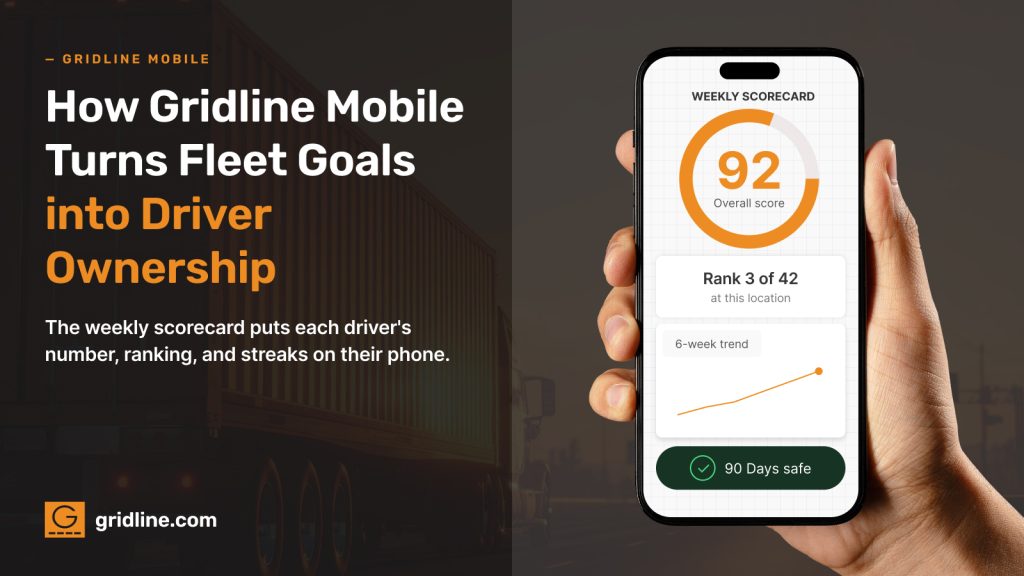
Feedback that only arrives when something goes wrong teaches drivers to dread their own data. Gridline Mobile balances the picture with streaks, a gamification feature that recognizes what drivers are doing right. A driver might see that they have gone 78 days without an HOS violation or 60 days without a red light event, and that recognition builds on itself because nobody wants to break a long streak. Corporate teams and driver managers choose which behaviors the streaks track, so if speeding or following distance is the concern this quarter, those become the habits every driver is motivated to protect.
A scorecard can only change behavior when drivers open it and engage with what it shows. Gridline Mobile addresses this with a weekly acknowledgement button, where each driver confirms that they have reviewed their scorecard and the areas flagged for improvement. The action takes a second, but it matters, because the driver formally takes ownership of their numbers and the manager gains a clear view of who is engaging with their data. A driver whose scores are slipping and who has also stopped acknowledging their scorecard is telling you something worth acting on.
The payoff shows up on both sides of the app. The top benefits of driver acknowledgement in fleet management include:
On the management side, the pain point is time. Supervisors have traditionally spent hours building spreadsheets and combing through rows of data just to figure out which drivers need attention. The Gridline Manager App gives supervisors a mirrored view of the driver experience that covers every driver assigned to them in Geotab, complete with a current score and a trend line for each one. At a glance, a manager can spot the at-risk drivers, meaning those with low scores or numbers heading in the wrong direction, and focus there. Coaching changes as a result, because instead of a scheduled sit down built around a stale printout, a manager can catch a driver in the yard for two minutes with the trend already on screen. Short conversations like that, held consistently and grounded in numbers both people have already seen, do more for driver behavior than quarterly reviews ever did.
None of this is limited to heavy trucking. Landscaping crews, field service teams, and mixed fleets face the same challenge of connecting company goals to the people driving the vehicles. Gridline Mobile mirrors the scorecards fleets already run in Gridline Analytics, so fleets that run in-cab cameras can blend that safety data into the same scorecard alongside efficiency metrics like idle time and hours of service, while fleets without cameras can run everything on telematics data alone. If the vehicles generate data and the drivers log in, the platform can do its job.
Setting the right goal is half the work, and making sure the people responsible for it can see it, track it, and act on it every week is the other half. Gridline Mobile completes that loop by giving drivers ownership of their performance and giving managers the time to coach instead of compile.
What is the Gridline Mobile App?
The Gridline Mobile App is a driver and supervisor app that turns fleet telematics data into weekly scorecards, goal tracking, peer rankings, and streaks. It includes a Driver App, where drivers review and acknowledge their own performance, and a Manager App, where supervisors see the score and trend for every driver assigned to them.
How is Gridline Mobile different from Geotab?
Geotab is the platform that collects the telematics data and manages compliance functions like HOS logging. Gridline Mobile is a performance layer that runs on top of Geotab, translating that data into scorecards, goals, and gamification for the people in the field. The two work together rather than competing, with Geotab providing the foundation and Gridline Mobile driving the behavior change.
Do drivers need dash cameras to use Gridline Mobile?
No, cameras are not required. Fleets with in cab cameras can blend safety event data into the scorecard alongside efficiency metrics, while fleets without cameras can run the app on telematics data alone. The only requirement is that the vehicles generate data and the drivers log in.
How much time do drivers need to spend in the app?
Drivers typically spend only a few minutes at the start of each week. They review their Monday morning scorecard, acknowledge it, note the area that needs improvement, and set a personal goal before heading out on their route. The app stays deliberately simple so it never becomes another burden on a working driver.
How does Gridline Mobile support driver incentive programs?
The scorecard connects to the same metrics that determine bonuses, so drivers can see their incentive standing all quarter instead of discovering it at payout. Companies can also weight the scorecard around the behaviors their incentive program rewards, which keeps the app and the program pulling in the same direction.
What types of fleets benefit from Gridline Mobile?
Any operation with drivers can use it, including heavy trucking, distribution, construction, landscaping, and field service fleets. The scorecards mirror what fleets already run in Gridline Analytics, so the same goal setting discipline carries across mixed fleets of any size.
Gridline is a Geotab Elite Specialized Partner. To see Gridline Mobile in action, contact us for a demo.

Learn more about Gridline fleet management analytics by reaching out below: