The Real Work Starts After the Sale: How Gridline Redefines Customer Success in Fleet Management
ELD tampering and falsification are a major Roadcheck focus this year. Here’s how fleet teams can prepare.
By Gridline Editorial
3 mins to read
The day a fleet signs with Gridline isn’t the day the work is finished. It’s the day the real work starts. It’s easy for a telematics provider to pour everything into winning the deal and then ease off once the contract is signed, but a fleet’s needs don’t stand still. Gridline treats customer success as everything that happens after the sale, because that’s where the value a fleet was promised is actually delivered. And the most indispensable customer success teams adapt with a fleet’s varying priorities and challenges as they come.
The strongest telematics relationships are two-way partnerships. Gridline shows up continuously for the fleets it already serves, and the payoff compounds when those fleets engage with it as a strategic partner rather than a help desk. Here’s what that looks like in practice.
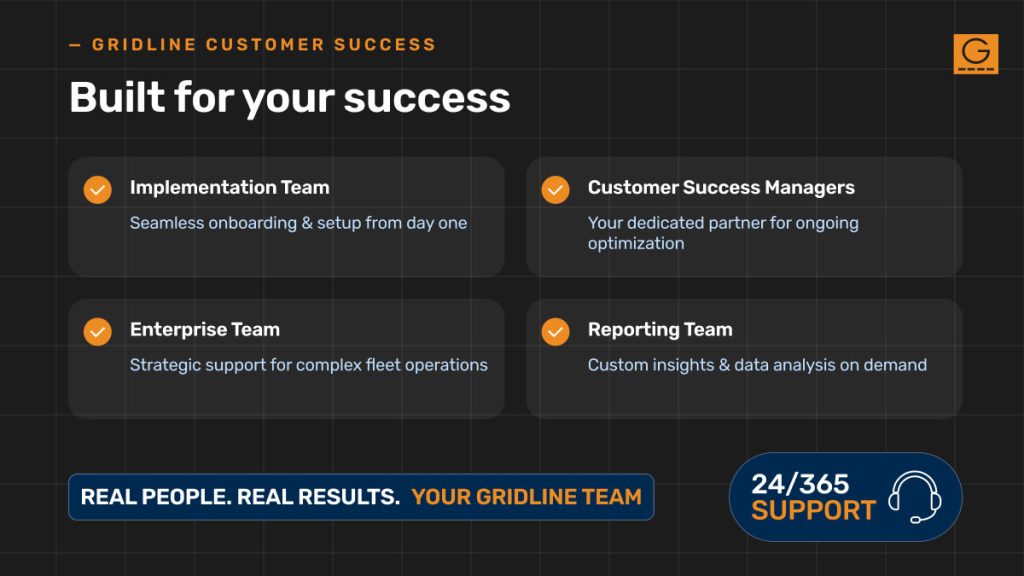
A lot of providers sell a platform and leave the operator to assemble the support around it. Gridline made a deliberate choice to build every post-sale function in-house:
A USA based support team available 24/365
Its own implementation team
Experienced customer success managers
A dedicated enterprise team
Reporting team
None of it is gated behind a premium tier or a white-glove upsell. The person who answers the phone at 2 a.m. is a Gridline employee, not an outsourced call center. That structure reflects a belief that customer success isn’t one team’s job. The support rep, the implementation specialist, and the customer success manager all own the outcome together.
Retention is a byproduct, not the goal
Most companies start with retention and work backward. Gridline flips it. Retention is the result of good work, not the starting point, and the work comes down to three things:
Sense of urgency. Working with purpose and moving things forward. It isn’t about doing more, it’s about doing the right work.
Communication. Clear, concise, accurate, and timely. Gridline can’t always control the problem, but we can always control the communication.
Engagement. Proactive, consistent, and personalized. Rather than casting a wide net, Gridline aims to know a fleet’s business well enough to name the problem precisely and bring the fix to match.
Do those three things well, and trust follows. “Retention is simple to say and hard to do,” says Chris Moberly, who leads Customer Success at Gridline. “The teams that win are the ones with the discipline to do the right work every week, not the most work.”
Gridline brings answers before fleets ask
A relentless focus on current fleets means Gridline is an extension of your team. Our customer success managers dig into fleet data proactively, spot what’s costing an operator time or money, and bring the answer before the question gets asked. Sometimes that’s unlocking a feature the operator already has; sometimes it’s building something new. And Gridline puts real numbers behind it: idling running at 22 percent against a 10 percent target can quietly cost a fleet six figures in a single quarter, and the data to see it is often already sitting in the platform the operator has today. Gridline’s job is to surface it, explain it, and help them act.
The point of all that proactivity isn’t to look clever, it’s to make the operator the hero. The job isn’t to make Gridline look good; it’s to make the people it works with look good. Gridline’s whole focus is helping that team execute and deliver, so they bring value to their own organization. The spotlight belongs on them.
Value that shows up early
During the sales process, the KPI’s are determined to drive the customers’ initiatives forward by leveraging this technology. Gridline then anchors implementation to those KPI’s instead of starting from a blank page, so the operator sees results fast. Get that right early and the value is obvious from the outset; miss it, and a fleet can run for years without the problem it bought the system to solve ever getting solved. Support follows the same logic. Operators rarely stay because support is good, but they will leave over support that’s bad, so Gridline treats reliability as the floor, not a selling point, and tailors it to each fleet’s specific operating rules.
A partnership, by design
For Chris, all of this rolls up to one idea. “The relationships that work best are the ones where we’re genuinely aligned on the same goals,” he says. “That’s not a tactic we turn on. It’s the whole job.” That’s the two-way street. Gridline brings the expertise, the proactive insights, and the steady attention; the fleets that lean in and treat Gridline as a strategic partner are the ones that get the most out of it. Partnership drives success, and for Gridline, that’s what Purposeful Innovation for Driver Success looks like once the sale is over and the real work begins. Request a demo or get in touch to learn more.
Turn your fleet data into profitable actions
Learn more about Gridline fleet management analytics by reaching out below:
We use cookies to ensure that we give you the best experience on our website. If you continue to use this site we will assume that you are happy with it.