Ask a safety manager why they have not rolled out driver-facing cameras yet, and you will rarely hear a complaint about price or picture quality. You will hear about people. Drivers do not want a lens pointed at their face for ten hours a day. Safety directors worry about pushback, grievances, and turnover in a market where every seat is hard to fill. The technology makes obvious sense, and yet the project sits in limbo because nobody wants to be the one who broke trust with the cab.
That hesitation is reasonable. It is also, increasingly, out of date. The conversation around fleet dash cam driver privacy has moved a long way from the early days of always-on inward recording, and the hardware has moved with it. The Geotab GO Focus Plus was designed around the exact objections drivers raise, with privacy controls built into the camera and the platform rather than bolted on afterward. Get the rollout right, and driver-facing video stops being a fight and becomes one of the easiest wins in your safety program.
It helps to be precise about what drivers are actually objecting to, because privacy covers several different worries that each have a different answer.
These driver-facing camera concerns are not irrational, and dismissing them is how adoption projects die. But notice that none of them are objections to safety. Drivers are not arguing that tailgating is fine or that phone use behind the wheel is harmless. They are objecting to a specific implementation: always recording, always watching, always pointed at them. Change the implementation and you change the conversation.
Driver privacy is not only a morale issue. In several states it is a legal one, and the law tends to reward fleets that collect less and disclose more.
The sharpest example is Illinois and its Biometric Information Privacy Act (BIPA). Many AI dash cams use facial geometry to detect fatigue or distraction, and a scan of face geometry is exactly what BIPA regulates. The law requires written notice explaining what is collected, why, and how long it is retained, plus written consent before collection begins. The penalties are not theoretical: statutory damages run to 1,000 dollars per negligent violation and 5,000 dollars per intentional one. One video-telematics vendor settled BIPA claims from Illinois drivers for 4.25 million dollars in early 2025, and a federal judge let a separate BIPA case over driver-facing cameras at an Illinois carrier proceed later that year.
Audio adds another layer. Several states require all-party consent to record a private conversation. Video-only surveillance of a workplace is generally lawful; quietly capturing in-cab audio on top of it can create exposure even when the video itself is unobjectionable. The practical lesson is consistent: the fleets least likely to end up in court are the ones that capture only what they need, tell drivers exactly what is happening, and can prove it. AI fleet camera privacy is no longer a soft topic for the HR binder; it is a design constraint that good hardware should help you meet.
None of this is legal advice, and requirements vary by state and change often. Treat it as a reason to involve counsel early, and to choose equipment that makes compliance the default rather than a setting you have to remember to switch on.
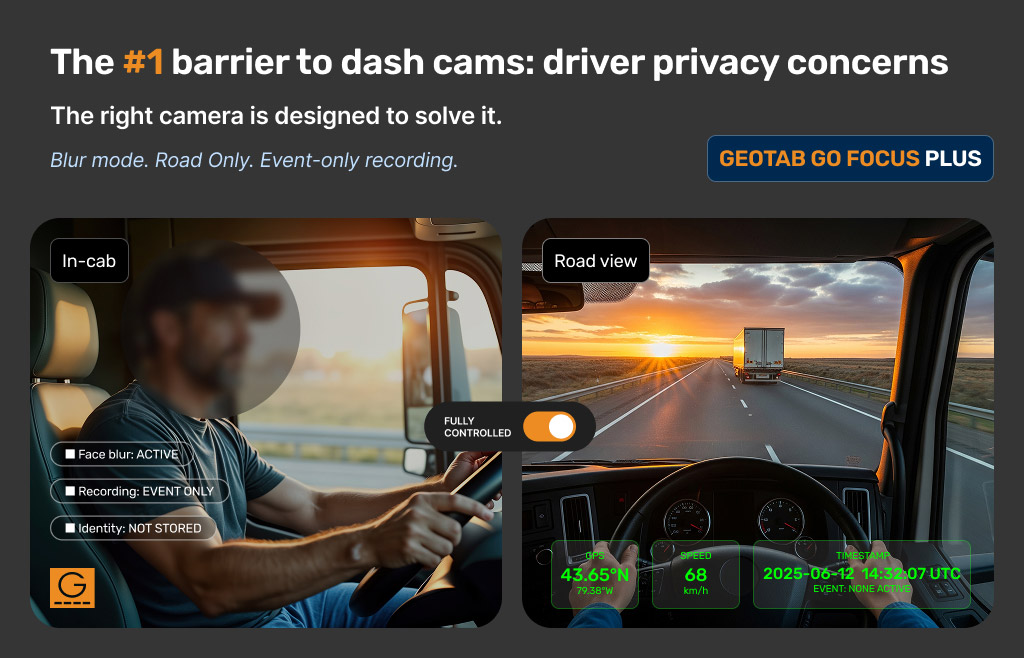
Most advice on this topic stops at the soft stuff: communicate early, write a clear policy, frame it as safety. All true, all necessary, and all insufficient if the hardware itself forces an all-or-nothing choice between safety and privacy. The more useful question is what the camera lets you do. This is where the GO Focus Plus earns its place, because its privacy features are engineered in three distinct ways that map directly onto the three driver objections above.
Put those three design choices together and the all-or-nothing trade-off disappears. You are no longer choosing between a blind fleet and a surveilled one. You are choosing how much identity to capture, when to capture it, and whether to look inside the cab at all.
Good hardware lowers the barrier; a good rollout clears it. Lead with coaching, not gotchas. Carriers see materially higher acceptance when in-cab footage feeds driver coaching and training rather than disciplinary files, industry research has put approval of driver-facing cameras roughly 87 percent higher when the program is built around proactive safety use. GO Focus Plus leans into this with real-time, in-cab voice coaching that alerts the driver the moment a risk is detected, so most events get corrected in the cab and never become a meeting.
Be transparent and specific. Tell drivers what the camera captures, when it records, what is blurred, how long footage is kept, and who can see it. Where biometric processing or audio is involved, get written consent and keep the notice plain. Then show the upside early: driver-facing video is also the driver’s best witness, exonerating them when another motorist is at fault. Pair that protective value with results managers can see, in one large Geotab pilot, in-cab voice coaching cut tailgating by about 90 percent and phone use by about 95 percent, and the camera stops being something done to drivers and becomes something that works for everyone in the operation.
Hardware is only half the story. A camera that flags events still leaves you with a queue of clips and a question: what do we actually do about them? As a Geotab Elite Specialized Partner, Gridline Telematics is the analytics and platform layer that turns GO Focus Plus events into operational decisions, connecting dash cam safety events with the rest of your telematics picture, from driver performance scorecards to fuel, idle, and compliance data, in one vertically integrated view.
Privacy-respecting hardware and a coaching-first program only deliver if the day-to-day workflow reinforces them. Gridline helps you stand up the rollout that makes driver-facing video an easy win: the right camera configuration for your fleet and jurisdiction, coaching workflows that build trust rather than erode it, and reporting that proves the safety case to drivers, executives, and a courtroom.
Driver privacy is the number one barrier to fleet dash cam adoption. With the right camera design and the right rollout behind it, it is also the one you can clear the fastest. Schedule a demo with the Gridline team.
Learn more about Gridline fleet management analytics by reaching out below: