Measure Fleet Performance by Manager or Supervisor, Not Just Location, Depot, Market
ELD tampering and falsification are a major Roadcheck focus this year. Here’s how fleet teams can prepare.
By Gridline Editorial
3 mins to read
Nearly every telematics platform organizes performance data by geography: drivers roll up to a location, and locations roll up to a region. That hierarchy is fine for mapping where your vehicles live, but it falls apart the moment you try to use it to manage people. This is because a depot is not a person. For example, one location might have four supervisors, each responsible for a different set of drivers. If the depot’s performance numbers slip, there is no one specifically accountable, so everyone can point somewhere else and the number never gets owned.
With Gridline Analytics, that changes. The same reports you already run can roll up to the person responsible for the drivers, not just the place where the trucks park.
Location reporting answers where a problem is happening, but not whose it is, and that gap shows up quickly in day-to-day operations. A depot report has no single owner, so follow-up depends on goodwill rather than responsibility. At the same time, supervisors end up being graded together even though their drivers, routes, and habits differ, and coaching assignments blur when several managers or supervisors share one location. The result is plenty of reporting activity with very little ownership for performance.
Gridline approaches this differently by adding a second lens to the same data. Alongside your location groups, every driver can roll up to a named person, whether that is a safety manager, a delivery supervisor, or a location manager. Once that structure is in place, the reports you already run can be grouped by name instead of by depot, and nothing about your existing location reporting has to change.
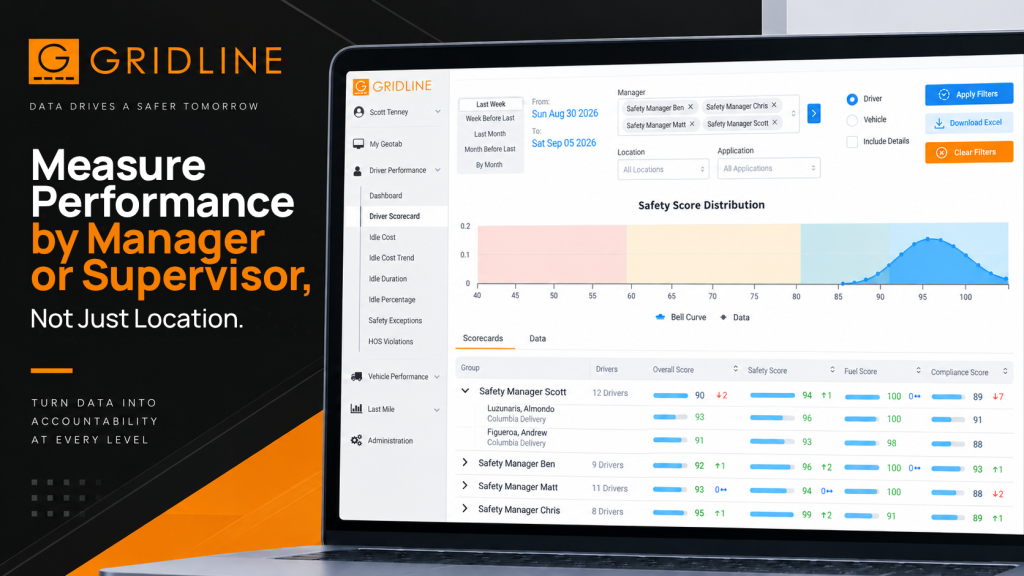
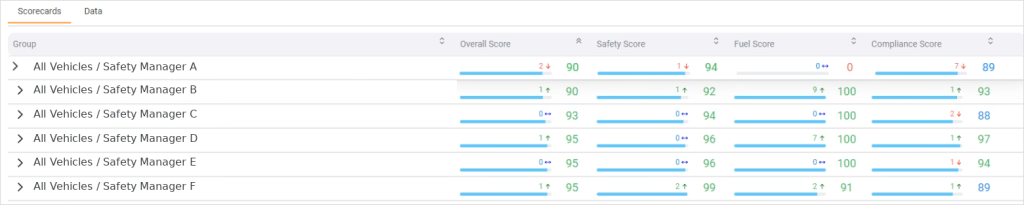
The effect is immediate. You can rank supervisor performance side by side against the fleet average, spot the one trending behind, and then click into their group to see exactly which drivers are moving the number. Because the whole chain from manager down to driver sits in a single view, the conversation shifts from “this depot has a problem” to “these drivers need coaching, and here is who coaches them.”
What rolls up to each name
Once drivers are assigned to a name, the full reporting suite follows. Each manager’s group carries:
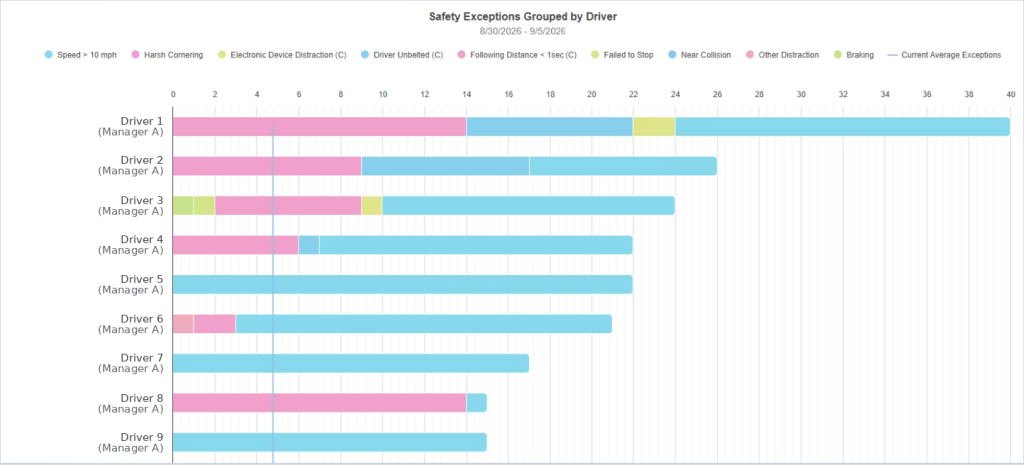
Safety exceptions, from speeding and harsh cornering to distraction and seatbelt events, charted against the fleet average
Driver scorecards with safety, fuel, and compliance scores for the group
Idle percentage, duration, and cost, so wasted fuel has an owner too
A full drill-down from the manager’s total to the individual driver behind it
Results can also be normalized per 100 miles, which keeps the comparison honest: a manager whose drivers run heavy mileage is measured fairly against one covering short local routes, and nobody is penalized for carrying the bigger workload.
Accountability changes behavior
The reason this works comes down to ownership. A report about a depot is information, but a report about your own drivers is a to-do list. When safety and fuel numbers are distributed under someone’s name, coaching stops being a shared chore and peer comparison starts doing the motivating, which is exactly when driver performance begins to improve. Fleets evaluating Gridline consistently call this out as a differentiator, and it has already been a deciding factor in recent wins.
Getting started is lighter than it sounds. You define who each driver rolls up to, and safety, scorecard, idle, and fuel reporting follow that structure automatically. To see your fleet’s numbers grouped by the people responsible for them, schedule a Gridline demo.
Frequently asked questions
Can Gridline report fleet performance by manager instead of location?
Yes. Alongside standard location and region groups, Gridline lets every driver roll up to a named person, such as a safety manager or delivery supervisor. Safety exceptions, driver scorecards, idle, and fuel efficiency reports can all be grouped and filtered by that name, down to the individual driver.
Do we lose location reporting when we group by manager?
No. Location and region groups stay exactly as they are. Grouping by person is an additional lens on the same data, so you can switch between where a problem is happening and who is responsible for fixing it.
Is reporting by manager part of Gridline Analytics?
Yes. Reporting by name is part of Gridline Analytics, the analytics layer that sits on top of your Geotab telematics data and also handles normalization, benchmarking, and goal setting. That combination matters because a goal only moves when someone owns it, and manager-level rollups put a name beside every target.
Turn your fleet data into profitable actions
Learn more about Gridline fleet management analytics by reaching out below:
We use cookies to ensure that we give you the best experience on our website. If you continue to use this site we will assume that you are happy with it.