The numbers behind why distracted driving is a fleet-wide compliance, safety, and liability issue. Every April, the National Safety Council and NHTSA mark National Distracted Driving Awareness Month, a dedicated push to confront one of the most persistent and preventable threats on American roads. For 2026, NHTSA’s campaign theme says it plainly: Put the Phone Away or Pay.
But for safety managers running heavy trucks, the stakes go well beyond a traffic ticket. Distracted driving touches every corner of fleet operations: CSA scores, DOT audits, insurance renewals, litigation exposure, and most importantly, the lives of drivers and the public. A single texting violation can ripple through a carrier’s safety record for years.
We pulled together ten of the most important distracted driving statistics from official government and industry research sources, all published within the last two years, to help fleet safety teams put the risk in perspective and spark meaningful conversations with drivers, leadership, and stakeholders this April.
According to NHTSA’s 2024 fatality data released in April 2026, distracted driving crashes claimed 3,208 lives in 2024. An additional 315,167 people were injured. To put it another way, that’s an average of roughly nine people killed and more than 860 people injured every single day because a driver’s attention was somewhere other than the road.
And safety experts believe even those numbers are understated. As NHTSA Administrator Jonathan Morrison noted at the 2026 Distracted Driving Awareness Month kickoff event, “no standardized method exists to reliably capture distraction as a contributing factor in crashes.” The true toll is almost certainly higher.
Source: NHTSA, Traffic Safety Facts – Distracted Driving 2024
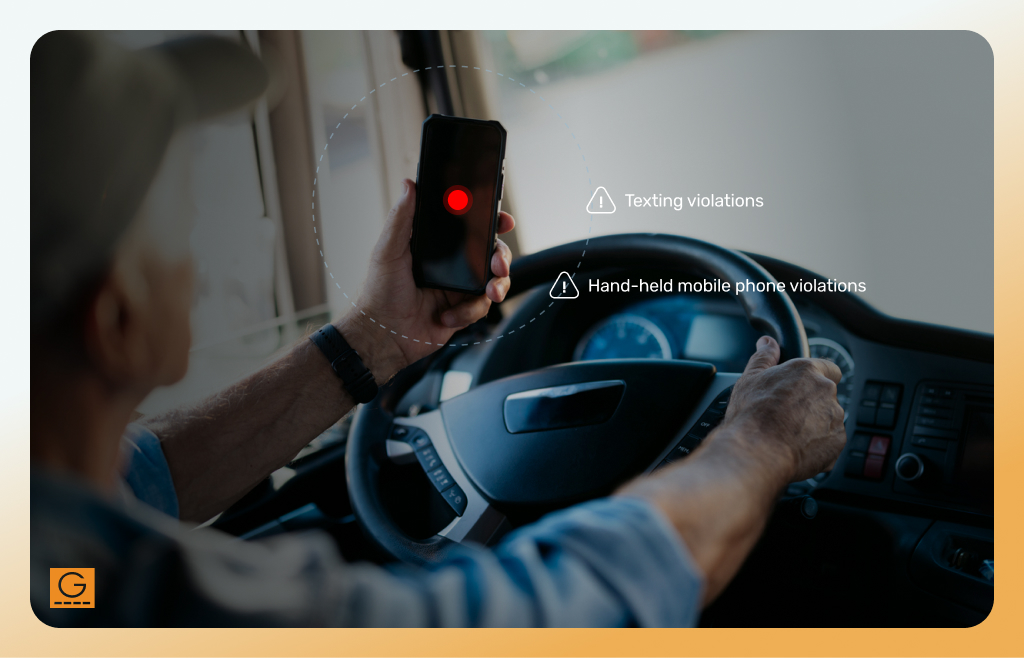
The statistic that launched the federal texting ban still carries enormous weight: FMCSA-commissioned research found that commercial motor vehicle drivers who text while driving are 23.2 times more likely to be involved in a safety-critical event, including a crash, near-crash, or unintentional lane departure, compared to drivers who don’t. Texting drivers took their eyes off the road for an average of 4.6 seconds. At 55 mph, that’s the equivalent of traveling the length of a football field, end zones included, completely blind.
Even dialing a handheld phone, even without texting, increases the risk sixfold. That’s why FMCSA’s rules go beyond texting to prohibit holding a phone, dialing more than one button, or reaching for a device in a way that takes a driver out of their normal seated position.
Source: FMCSA, No Texting Rule Fact Sheet; FMCSA, Mobile Phone Restrictions Fact Sheet
A foundational FMCSA study found that in 71 percent of large-truck crashes, the driver was engaged in some activity other than driving, whether that was texting, eating, adjusting a GPS, or simply looking at something outside the cab. The study also found that 80 percent of crashes and near-crashes involved some form of driver inattention in the three seconds immediately before the event.
For safety managers, this is a powerful training message: the moment of distraction is usually just seconds long, but its consequences can be permanent.
NHTSA’s Fatality Analysis Reporting System recorded 5,472 deaths in crashes involving large trucks in 2023, with an estimated 153,452 people injured and over 528,000 large trucks involved in police-reported crashes nationwide. Roughly 80 percent of fatal large-truck crashes involved multiple vehicles, meaning the majority of victims were occupants of smaller passenger vehicles, not the truck itself.
While not all of these crashes were caused by distraction, these numbers illustrate why any factor that degrades a truck driver’s attention has outsized consequences. The physics of an 80,000-pound vehicle leave almost no margin for error.
Source: NHTSA, Large Trucks: 2023 Data (Traffic Safety Facts, DOT HS 813 717, April 2025).
Under FMCSA’s Compliance, Safety, Accountability (CSA) program, not all violations are scored equally. The Safety Measurement System (SMS) methodology assigns a severity weight of 10, the maximum possible, to texting violations, handheld mobile phone violations, and the corresponding carrier-level “allowing or requiring” variants. That means a small number of distraction-related violations can spike a carrier’s Unsafe Driving BASIC percentile far more than many other violation types.
A poor Unsafe Driving BASIC score can trigger FMCSA interventions, affect insurance underwriting, and become exhibit A in litigation. Safety managers who treat distracted driving violations as “just tickets” are underestimating the scoring math.
Source: FMCSA, SMS Methodology document (csa.fmcsa.dot.gov).
Federal rules don’t just penalize the driver. Under 49 CFR 392.80 and 392.82, a motor carrier may not allow or require a driver to text or use a handheld phone while operating a CMV. Drivers face civil penalties of up to $2,750 per violation, while carriers face fines up to $11,000. Multiple offenses can result in CDL disqualification for 60 to 120 days, classified under the same framework as “serious traffic violations.”
The carrier-level accountability is the key detail many operators miss. If an investigation reveals that dispatch practices, device configuration, or weak policy enforcement effectively allowed prohibited behavior, the company is exposed, not just the individual driver.
Source: 49 CFR 392.80, 392.82; FMCSA, Distracted Driving page; 49 CFR 383.51 (CDL disqualification).
The Commercial Vehicle Safety Alliance’s annual Operation Safe Driver Week puts officers on the roadside looking specifically for dangerous driving behaviors. In 2024, CMV drivers received 115 citations and 91 warnings for texting or handheld device use. In 2025, the numbers were 79 citations and 107 warnings. These aren’t hypothetical risks. Distracted driving enforcement is active and consistent, year over year, even when it’s not the primary campaign focus.
For safety managers, every one of those citations feeds into a driver’s and carrier’s safety record. Proactive coaching and clear policies are the best defense against becoming part of next year’s count.
Source: CVSA, 2024 Operation Safe Driver Week Results; CVSA, 2025 Operation Safe Driver Week Results.
The nuclear verdict trend isn’t slowing down. It’s accelerating. According to the Marathon Strategies “Corporate Verdicts Go Thermonuclear” 2025 report, verdicts exceeding $10 million hit a record 135 cases in 2024, a 52% increase over 2023. The trucking and automotive sectors alone accounted for 15 major verdicts totaling over $4.1 billion. Meanwhile, ATRI’s forensic analysis of trucking litigation found that the median nuclear verdict reached $36 million in 2022, roughly 50% higher than a decade earlier.
What does distracted driving have to do with nuclear verdicts? Everything. Plaintiff attorneys use distracted driving allegations to pivot from “accident” to “preventable corporate negligence,” opening the door to arguments about training failures, dispatch pressure, and weak safety programs. Fleets that can’t produce evidence of a robust, documented safety culture become vulnerable to outsized awards.
ATRI’s research found that in more than 80 percent of trucking verdicts exceeding $1 million, non-medical damages, including pain and suffering, punitive awards, and loss of consortium, ran as high as ten times the actual medical bills. Plaintiffs’ attorneys often present the initial billed amount rather than what was actually paid, a practice sometimes called “phantom damages.” Combined with “reptile theory” trial strategies that frame trucking companies as ongoing public safety threats, these dynamics push verdicts well beyond what the underlying injuries might suggest.
For fleet operators, this underscores a critical point: the cost of a crash isn’t determined by the medical bills alone. It’s determined by whether a jury believes your company took safety seriously, or cut corners. A documented, enforced distracted driving policy with evidence of coaching and follow-through is one of the strongest defenses against inflated awards.
Source: ATRI, Trucking Litigation Report (December 2025).
The good news: NHTSA’s preliminary estimates show that 2025 saw an estimated 36,640 traffic fatalities, down 6.7% from 2024, returning to pre-pandemic levels last seen in 2019. The fatality rate hit 1.10 per 100 million vehicle miles traveled, the second-lowest in recorded history.
The cautionary note: distracted driving remains one of the most underreported contributing factors in crashes. As NHTSA has acknowledged, distraction is difficult to detect and document after a crash occurs. The improving overall trend is encouraging, but it doesn’t mean fleets can ease up. For heavy-truck operations, a single preventable crash can undo years of safety investment: operationally, financially, and reputationally.
Source: NHTSA/U.S. DOT, 2025 Traffic Death Estimates & 2024 FARS (April 2026).
Taken together, these ten statistics paint a clear picture: distracted driving is not a minor compliance checkbox. It’s a systemic risk that touches safety scoring, enforcement exposure, insurance costs, litigation outcomes, and above all, human lives.
April is the right time to revisit your fleet’s approach. Here are a few questions worth asking:
Distracted driving is 100% preventable. That’s what makes it both the most frustrating and the most actionable safety challenge fleets face. This Distracted Driving Awareness Month, take the time to look at the data, talk to your drivers, and make sure your safety program reflects what’s actually at stake. From real-time driver coaching to video evidence that holds up in court, Gridline gives fleet safety teams the tools to turn compliance into a competitive advantage. See it in action.

Learn more about Gridline fleet management analytics by reaching out below: