Fleet video programs often stall for two predictable reasons: drivers feel surveilled, and safety managers drown in footage. Geotab’s GO Focus Plus is designed to break that cycle with an integrated detect, coach and verify workflow that surfaces urgent risk faster. The goal is to make managers more effective coaches, not more efficient video editors.
The numbers make the case for prioritization. Distracted driving crashes in 2024 resulted in over 3,200 fatalities and more than 315,000 injuries in the United States alone, according to the National Highway Traffic Safety Administration. FMCSA rules already restrict mobile phone use for commercial drivers, which means fleets are managing a behavior that carries both high crash risk and high regulatory exposure.
The emerging best practice across telematics is to alert on what can be corrected in the moment and coach the rest later. Research from Together for Safer Roads warns that too many in-cab alerts create fatigue, which undermines the very coaching they are meant to support. Smart Sequence applies that same logic to the manager’s workflow by filtering and ranking events so that the most critical ones rise to the top.
Modern AI dash cams can detect a wide range of risky behaviors: tailgating, rolling stops, lane departures, harsh braking, phone use, seatbelt violations and more. That detection capability is a major step forward from traditional cameras that simply record and store footage. The challenge is that more detection means more events, and more events can overwhelm the people responsible for acting on them.
A fleet of 200 vehicles generating even a handful of flagged events per driver per week can produce thousands of clips for a safety manager to review. Without a way to sort by urgency, managers either review everything (unsustainable) or cherry-pick at random (ineffective). The result is the same: high-risk behaviors slip through while time gets spent on low-priority footage.
This is where event prioritization becomes essential. The value of an AI dash cam program is determined less by what the camera can detect and more by how effectively the fleet can act on what it finds. Prioritization is the bridge between raw detection and meaningful coaching.
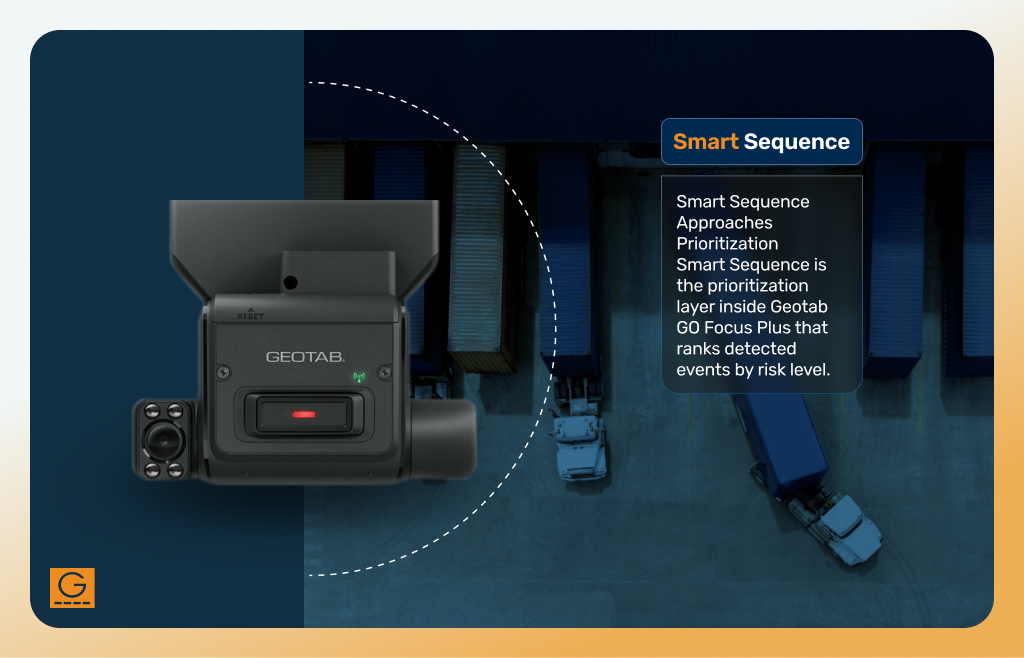
Smart Sequence is the prioritization layer inside Geotab GO Focus Plus that ranks detected events by risk level. Instead of presenting managers with a chronological stream of clips, it builds a queue where the first videos reviewed are the ones most likely to require action. Severity, frequency and driver-level scoring all factor into the ranking, while routine and false-positive events get pushed down.
Each flagged event includes a preview of the most impactful moment along with contextual data like speed, location and event type. Managers can assess what happened and decide on next steps without scrubbing through full clips. The system also identifies compound risks, such as a driver who is distracted while tailgating, and flags those ahead of isolated, lower-severity incidents.
Pattern recognition adds another layer. Rather than treating every event as standalone, Smart Sequence tracks repeat behaviors across drivers and across the fleet. This lets managers focus coaching on the drivers and habits that represent ongoing risk, rather than reacting to one-off events that may not indicate a trend.
Detection and prioritization only matter if they lead to behavior change. The most effective fleet coaching programs share a few common traits: feedback is timely, conversations are grounded in evidence, and drivers feel the process is fair. A ranked event queue supports all three by giving managers the right clip, with the right context, at the right time.
A coaching conversation about an event that happened three weeks ago has far less impact than one that happens the same day. When prioritization surfaces the most urgent events quickly, managers can address them while the behavior is still fresh in the driver’s memory. That speed turns a review task into a meaningful safety conversation.
If the wrong driver gets coached because of a misidentified event, trust in the entire program erodes. GO Focus Plus addresses this with Smart Driver ID, which offers options from manual NFC/RFID identification to AI-recommended and fully automated driver assignment. Correct attribution is the foundation that makes every downstream coaching conversation credible.
One of the most common mistakes fleets make with AI dash cams is alerting on everything. The logic seems sound, where if the camera can detect it, the driver should know about it. In practice, this approach tends to backfire. Drivers who receive constant alerts start ignoring them, and the alerts that actually matter get lost in the noise.
Together for Safer Roads recommends a two-tier approach:
Threshold tuning plays a direct role here. Geotab’s documentation on camera rules and thresholds emphasizes that sensitivity settings should be calibrated to match fleet type and operating environment. A heavy truck fleet and a last-mile van operation have very different baselines for what constitutes harsh braking or a close following distance. Better thresholds reduce nuisance events, which makes both in-cab alerts and the manager’s review queue more trustworthy.
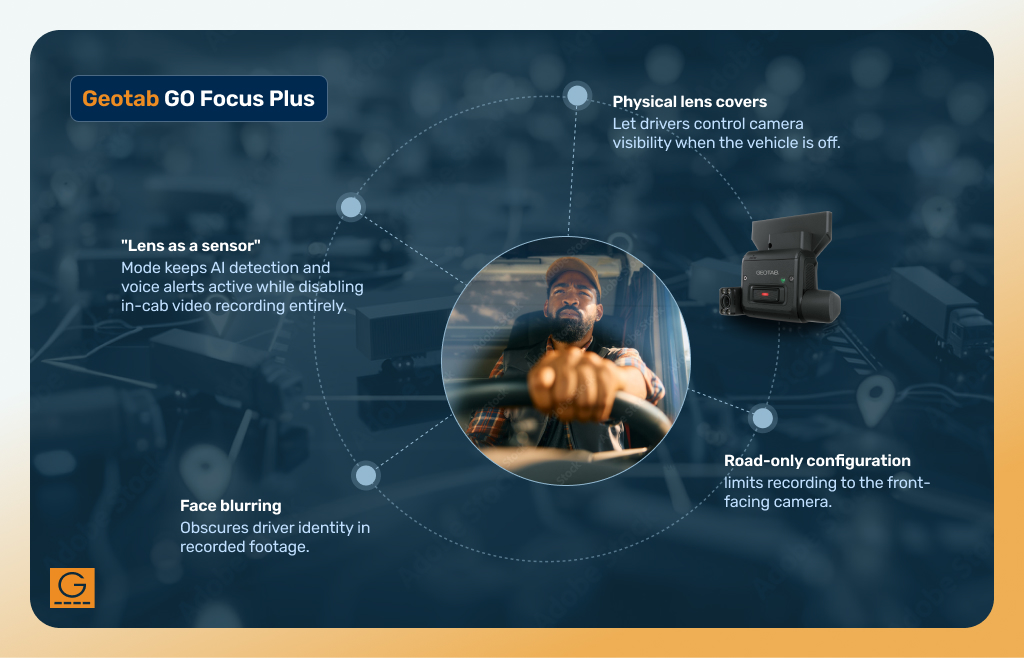
Driver facing cameras can be a hard sell in many fleets. Privacy concerns are the most frequently cited reason for driver resistance, and programs that ignore those concerns tend to stall during rollout. The fleets that succeed treat privacy configuration as an adoption strategy and not an afterthought.
GO Focus Plus gives fleets several ways to address driver concerns:
The technology alone does not solve the adoption problem. Drivers who understand what is and is not being recorded are far more likely to accept the program. Fleets that involve drivers in the conversation during rollout, rather than presenting cameras as a mandate, consistently report faster adoption and better long-term results.
A prioritization system is only as useful as the outcomes it drives. Fleets should track a handful of metrics that connect dash cam data to real safety improvement. Event volume over time shows whether coaching is reducing risky behaviors. The ratio of high-severity to low-severity events indicates whether the fleet’s risk profile is shifting in the right direction.
Geotab reports that fleets using connected coaching workflows recorded up to 40 percent fewer collisions in validation testing, and a separate pilot saw a 95 percent reduction in driver phone use after enabling voice coaching. These are Geotab-reported figures, but they illustrate the kind of measurable outcomes that justify a program’s investment.
Tools like the Driver Distraction Score, which tracks risk on a rolling 30-day window, help managers see whether individual drivers are improving or need additional intervention. Tracking these trends over time turns a dash cam program from a reactive tool into a proactive safety strategy.
Fleets considering an AI dash cam program should resist the urge to turn on every feature at once. A phased approach works better. Start with a small pilot group, limit real-time alerts to two or three critical behaviors, and use the first 30 days to calibrate thresholds and establish a coaching rhythm.
Involve drivers early. Explain what the cameras detect, what managers will see and what privacy options are available. Programs that launch with transparency build trust faster than those that rely on policy mandates alone.
Once the pilot group is stable, expand gradually and let the data guide decisions. The goal is a system where managers spend their time coaching the right drivers on the right behaviors, rather than sifting through footage looking for problems. That shift from manual review to prioritized coaching is where the real safety gains happen.
Gridline is a Geotab Elite Specialized Partner. To learn more about GO Focus Plus and how Smart Sequence can streamline your fleet safety program, contact us for a demo.
Learn more about Gridline fleet management analytics by reaching out below: