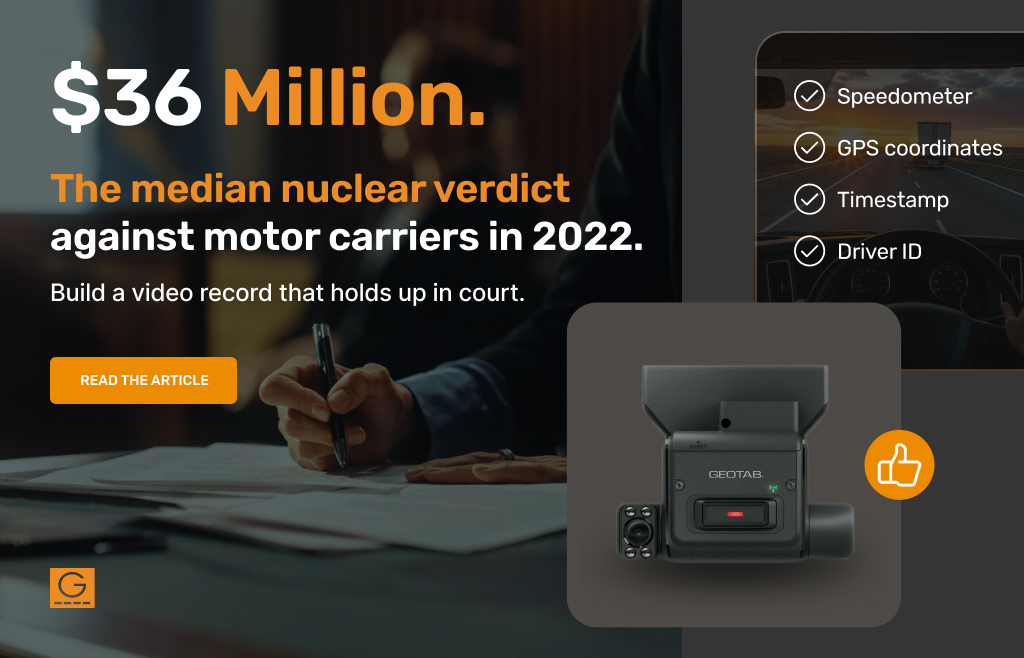
Jury awards against motor carriers are growing at a pace that makes every collision a high-stakes event. The American Transportation Research Institute reports that the median nuclear verdict reached $36 million in 2022, roughly 50 percent higher than the 2013 figure, while the share of verdicts above $50 million has continued to climb. Tractor-trailer tort filings grew at an average annual rate of 3.7 percent between 2014 and 2023, and commercial auto liability costs are now rising about 10 percent each year, well ahead of inflation.
Insurance premiums reflect that pressure. Industry surveys put recent annual commercial truck insurance increases between 35 and 40 percent for low to average risk carriers. For fleet safety managers and risk officers, the message is clear. Defending a claim now requires more than safe drivers and a clean accident report. It requires evidence that can stand up to a courtroom strategy built around emotion, social inflation, and reptile theory tactics.
What Courts Look For in Video Evidence
Footage on its own does not always make it into the courtroom. To be admissible, video must satisfy three pillars: authenticity, integrity, and a verifiable chain of custody. The footage has to be tied to a specific device, timestamped accurately, traceable to a known driver, and free from any sign of editing or tampering.
Courts pay particular attention to metadata. A video without verifiable timestamps, GPS coordinates, or device identifiers gives plaintiff attorneys an opening to argue that the footage was cherry-picked or modified. Counsel will also question whether the recording captured the full sequence of events rather than a convenient snippet, and whether the driver shown is actually the person who was behind the wheel.
Synchronizing video with telematics data is what transforms a clip into evidence. Speed at the moment of impact, GPS location, braking force, and steering inputs, when matched frame by frame with what the camera saw, build a record that is difficult to dispute.
Why Generic Dash Cams Fall Short
Many fleets still rely on standalone cameras that record continuously but offer little context. A clip showing a collision means little without proof of who was driving, how fast the vehicle was traveling, when the event occurred, and what risk behaviors preceded it. Storage limits also work against fleets. If footage is overwritten within 30 or 60 days, key evidence can disappear before a claim is even filed, while most insurance and litigation matters stretch well beyond that window.
A defensible record also depends on attribution. Vehicles in mixed use fleets often rotate between drivers, and a misattributed event can undermine the credibility of the entire safety program when a plaintiff attorney puts it under a microscope.
How GO Focus Plus Captures Defensible Footage
GO Focus Plus is built to close these gaps. The dual facing AI dash cam runs natively on the Geotab platform, which means video is paired with telematics data from the moment of recording. Speed, GPS coordinates, location, and event triggers are overlaid on every clip, producing footage that is contextually anchored rather than visually isolated.
Smart Driver ID uses passive facial verification to confirm who is behind the wheel throughout a trip, automatically updating the record if a driver swap occurs partway through a route. That removes one of the most common challenges to attribution and ties each event back to a specific person with documentation to support it.
Smart Sequence pulls the most critical moment of an incident into a single view. Video, speed, location, and what triggered the alert all sit together. For safety teams reviewing an incident months later, or for an attorney preparing a defense, the full context of an event is preserved and ready to present.
Footage is recorded continuously in 1080p HD, clear enough to identify faces and license plates if it is called into evidence. Cloud storage extends up to 365 days, well past the typical claims window, so footage remains available long after many systems have deleted it.
Building a Pattern of Proactive Safety
A legally defensible record is not built one clip at a time. It is built through a documented pattern of safe operations and consistent coaching. The GO Focus Plus AI dash cam connects every flagged event to a coaching workflow within MyGeotab, assigning sessions, tracking completion, and recognizing safe driving. Plaintiff attorneys often try to broaden cases well beyond a single incident, pointing to a carrier’s history, hiring practices, and safety culture. A documented coaching record, paired with telematics anchored video evidence, allows a fleet to push back with proof of an active, measurable safety program.
In an environment where verdicts can climb into the tens or hundreds of millions, the difference between a defensible record and an exposed one often comes down to whether the camera captured the full picture, attributed it correctly, and preserved it long enough to matter.
To learn how to build a proactive safety program, one which maintains defensible records of telematics data and video, schedule a demo with the Gridline team.
Turn your fleet data into profitable actions
Learn more about Gridline fleet management analytics by reaching out below:
We use cookies to ensure that we give you the best experience on our website. If you continue to use this site we will assume that you are happy with it.