British Columbia has become the first province in Canada to require dash cams on commercial vehicles. For fleet operators, the temptation will be to treat this as a box-checking exercise: buy a camera that meets the spec, install it, move on. That instinct is understandable, and it is a mistake. The same device the law now requires can cut your collision rate, defend your drivers when they are not at fault, and lower your insurance exposure, but only if it is connected to the rest of your fleet data instead of sitting in a silo. Here is what the mandate really says, and how to make the spend work harder than the law asks it to.
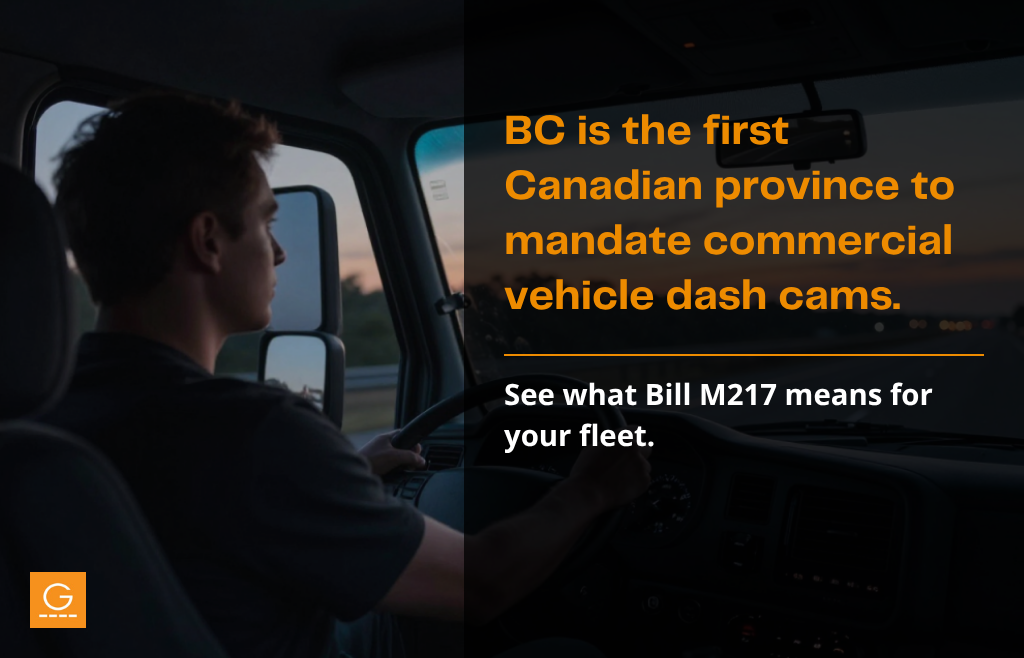
Bill M217, the Dashboard Cameras in Commercial Vehicles Act, passed all three readings in the B.C. Legislature with unanimous, bipartisan support in May 2026. Introduced by Kamloops-North Thompson MLA Ward Stamer following a series of fatal highway collisions involving commercial vehicles, the act requires a road-facing dash cam on every covered commercial vehicle operating in the province. The vehicle owner is responsible for installing and maintaining a compliant camera; for leased vehicles, that obligation shifts to the lessee. The operator must keep the camera recording continuously and unobstructed whenever the vehicle is in service.
The bill itself is technology-neutral, but the proposed technical baseline is clear: cameras must be forward-facing, record at 1080p or better, retain a minimum of 72 hours of footage, and have night-vision capability. Notably, driver-facing cameras are not required. During committee review, lawmakers deliberately limited the mandate to outward-facing systems after privacy concerns were raised, and any inward-facing camera a fleet chooses to add carries its own obligations under B.C.’s Personal Information Protection Act.
The mandate applies to commercial vehicles as defined in B.C.’s Commercial Transport Act, which covers most commercially operated trucks with a licensed gross vehicle weight above 11,793 kilograms, or roughly 26,000 pounds. Critically, the rule follows the road, not the registration. National Safety Code carriers operating under a B.C. licence are covered, and so is any in-scope commercial vehicle registered in another province, territory, or U.S. state that travels through British Columbia. If your trucks run the Alaska Highway or cross into B.C. for any leg of a route, this applies to you.
The act comes into force six months after it receives Royal Assent, the final formal step that turns the passed bill into active law. Fines and enforcement mechanisms have not yet been published; those will be set by the Commercial Vehicle Safety and Enforcement branch of the B.C. Ministry of Transportation, which already has authority to inspect commercial vehicles, issue out-of-service orders, and levy penalties under existing law. Six months sounds comfortable, but procurement lead times, fleet-wide installation scheduling, driver briefings, and policy updates compress that window quickly, especially when every operator in the province is trying to comply at once. The fleets that start now will have options. The ones that wait for the final fine schedule will be installing against a hard deadline.
A camera that only satisfies the mandate gives you one thing: a recording. That has real value the day an incident happens, but it is reactive by design. Consider the context that the B.C. Trucking Association has documented: commercial drivers are not at fault in an estimated 75% to 80% of collisions involving their vehicles. A forward-facing camera is, first and foremost, a tool that protects your drivers and your company from claims you did not cause. Footage turns a he-said-she-said dispute into a closed case, and it does so whether or not you ever use the camera for anything else.
But footage alone answers what happened, not why, and it does nothing to prevent the next event. The 72-hour retention floor is a good illustration of the gap between the minimum and the useful. Insurance adjusters, enforcement investigations, and legal proceedings routinely need video from a week or more before an event, not the three days the law requires. Meeting the letter of the mandate can still leave you without the footage you need when it matters most.
Modern AI dash cams close that gap. Instead of leaving your safety team to scrub hours of uneventful highway video, edge AI flags the moments that matter as they happen: harsh braking, rapid acceleration, following too closely, and signs of distracted driving. The footage becomes searchable by event rather than by timestamp, which is the difference between a tool your safety team uses daily and one they open only after a crash.
The bigger leap comes when that video is paired with the telematics data you are already collecting. Road footage shows the event; GPS, speed, harsh-event, and engine data show the conditions around it. Together they produce a complete, defensible record of any incident and, more importantly, a pattern view across your whole fleet. That is what lets you move from reacting to individual events toward coaching the behaviors that cause them, before they become claims. The mandate gets a camera into every cab. What you connect it to determines whether it lowers your loss rate or just records your losses.
This is where the choice of provider, not just hardware, decides the outcome. A dash cam that does not connect to your fleet management platform creates a second data silo. When something goes wrong, your team ends up cross-referencing video in one system against GPS and speed data in another, under exactly the time pressure where that friction hurts most. The setups that work pull footage and telematics into a single view, so the full picture of any event lives in one place.
Gridline was built for precisely this problem. As a Geotab Elite Specialized Partner, Gridline pairs compliant, AI-enabled video with an analytics layer that most providers do not offer. Our Driver Performance Scorecard combines telematics signals with dash cam safety events into a single, rankable measure of driver risk, so safety managers can see who needs coaching and why, not just that an event occurred. Where many vendors hand you a camera and a separate portal of dots on a map, Gridline consolidates asset tracking, compliance, and video into one operational view, and backs it with the kind of hands-on, human customer support most of the industry has quietly cut. The result is that a B.C. fleet getting compliant with Gridline does not just satisfy Bill M217. It comes out of the process with a measurable safety program, faster claim resolution, and a clearer line between fleet data and the bottom line.
Start by auditing which of your vehicles fall under the 11,793-kilogram threshold and which routes touch British Columbia, including occasional cross-border trips that operators sometimes overlook. From there, evaluate hardware against the proposed spec, but evaluate the platform behind it against a higher bar: does the camera feed into the same system as your telematics, does it surface events automatically, and can it produce the driver-level safety insight that turns compliance spend into lower risk? Schedule installation early, brief drivers on what is recorded and why, and update your internal policies, particularly if you add any inward-facing cameras subject to provincial privacy law. Handled well, the six months between Royal Assent and enforcement is not a compliance scramble. It is the runway to a safer, better-documented, more defensible fleet.
Gridline helps fleets across distribution, construction, and service do exactly that, turning the telematics and video data they already collect into operational intelligence and profit. If B.C. routes are part of your network, now is the time to plan the rollout, not after the fine schedule lands. Scheduling a call with our team is a great first step.

Learn more about Gridline fleet management analytics by reaching out below: